Showing posts with label Resources. Show all posts
Jan 18, 2014
Little Passports Review
May 31, 2013
CC and The Well-Trained Mind
If this is not your first time at the classical education rodeo, then you've probably run across The Well-Trained Mind at some point.
Susan Wise Bauer (author of The Story of the World series) and her mama, Jessie Wise, collaborated on this remarkable plan for classical education at home.
You may have guessed by now that I'm a Classical Conversations groupie, so to speak, and I fully support founder Leigh Bortins and her fabulous program. It has worked so well for our family, and you can read about my experiences here and here. Well, while surfing the internet doing my own research the other day, I ran across someone's blog post that called CC 'classical-lite' (we'll come back to that in a minute).
Hmm. . . that got me thinking. Is The Well-Trained Mind really the end-all-be-all for classical homeschoolers?
So, I thought I'd do a quick little comparison (I say 'quick' because I'm only going to touch on the biggest differences that matter to me. One could certainly spend more time dissecting and comparing both books, but I promise that I do have a life, and therefore I need time to get off the computer and live it. ;).
The Well-Trained Mind, 2nd Edition (WTM) vs. The Core by Leigh Bortins
To begin with, check out the size difference:
Both books discuss the Trivium at length in the beginning, giving explanations of the three stages of learning and development (grammar, logic/dialectic, and rhetoric). Bauer says the Trivium is a "three-part process of training the mind" (WTM, p. 13). I love this short-and-sweet definition!
Both books give a good overview of classical education:
Classical education is, above all, systematic. . . Rigorous study develops virtue in the student: the ability to act in accordance with what one knows to be right. . . Classical education continually asks a student to work against her baser tendencies (laziness or the desire to watch another half hour of TV) in order to reach a goal - mastery of a subject. . . Systematic study allows the student to join what Mortimer J. Adler calls the "Great Conversation": the ongoing conversation of great minds down through the ages. (WTM, p. 17)
The purpose of a classical education is to strengthen one's mind, body, and character in order to develop the ability to learn anything. (The Core, p. 15)
However, the biggest difference to me between these two books, which explains why The Core looks to be less than half the length of The Well-Trained Mind, is that The Core is not a comprehensive guide to classical education at home.
What?! But I'm new to CC and everyone keeps telling me to read The Core!
Yes, certainly read The Core if you're in CC, but do so knowing that its focus is on the grammar stage - the Foundations level of the program (children under 13). The first time I read it, I didn't understand that. If you're in CC, you may be happy to hear that Leigh's next book about the Essentials program (the next level up in Classical Conversations) is being released this Fall.
In contrast, WTM is everything in one place. Also, WTM presents a very detailed plan for every developmental stage. From the inside book jacket blurb:
This book will instruct you, step by step, on how to give your child an academically rigorous, comprehensive education from preschool through high school. . .
Yes, it certainly does!
There are detailed instructions for setting up a Language, History, and Science notebook for the earlier grades (p. 222), including exactly what to include in each tab and how much time to spend on each component. I like this and find the notebook ideas the most useful part of WTM for me right now. However, something is missing. See if you can spot it:
The history notebook should be accompanied by a certain amount of memorization. Dates, personalities, and wars serve as pegs on which to hang incoming information. . . You can pick your own "pegs." (WTM, p. 114)
Did you catch that?
As in any classical education curriculum, the Bauers stress memorization, but they don't tell you what to memorize (aside from the list of leaders and wars in the back of the Kingfisher History Encyclopedia).
I know what some of you might be thinking: What? Are you a baby that has to have things spoon fed to her?
Well, no, but if there's a program out there that already has these 'pegs' (quality content for memorization) ready to go, why reinvent the wheel? The main criticism I've heard of WTM is that it takes hours of preparation each week. Now, I can't speak from experience; I've yet to try its method, but this seems about right if the parent has to piece together the memory work each year as she goes.
Classical Conversations, the program described in The Core, already has memory work for 24 weeks in seven seminars (subjects). I don't have to go fishing for things to memorize each year. It seems to me that CC would fit in nicely with WTM. Therefore, I cannot agree with the blogger who called CC 'classical-lite.' I believe Classical Conversations can be used as a tool to provide the memory pegs for the classical education. To bring both views together, I can picture WTM as the car and CC as the map to get the car to its destination of a rigorous classical, Christian, home-centered education. Does that make sense? I'm sure some of you reading this have experience using the two together. Do they complement each other? I've pretty much decided that we're going to pick up some components of WTM next year when we start first grade, and I'm excited to see how our CC memory work will plug in. I say 'some' because we won't follow WTM's suggestions to the letter. For example, WTM uses The Story of the World series to cycle through all of history in four years. CC cycles through history in three years, so we would adjust WTM's notebook plan to fit our own schedule.
It is interesting to note here that in The Core, Leigh Bortins says that she didn't have a time each day to study history and science when her boys were younger, in the grammar level. Instead, she focused on the basics:
. . . we work very hard on memorizing (phonics, spelling, math) rules and facts and concrete ideas while practicing reading and writing and arithmetic. Brain training is paramount. . . History and science were not subjects we studied in our home-centered grammar school. Instead we read and wrote and calculated ideas concerning history and science. (The Core, p. 177, emphasis mine)
Back to our book comparison, both WTM and The Core stress the use of memorization, recitation, and copywork in the early grades (remember, The Core is focused only the the grammar stage of learning, but that does not necessarily mean younger children only. Anyone starting a classical education should begin in the grammar stage, regardless of age. Grammar is the basics of any subject, and they have to be mastered before moving into the logic/dialectic stage.) And while both books share other commonalities, the next difference I'd like to touch on briefly is that of worldview. First, it appears that WTM tries to appeal to a wider demographic by acknowledging God but leaving the worldview up to the reader:
Arguing for the presence of God is generally considered "biased." Assuming His absence is usually called "neutral." Yet both are statements of faith; both color the teacher's approach to any subject; both make a fundamental assumption about the nature of men and women. . . Education cannot be neutral when it comes to faith. . . You cannot learn - or teach - about humanity without considering God. . . separation of religious faith from education yields an incomplete education. . . Don't ignore instruction in (at the bare minimum) the facts of the world's major religions. Do try to relate the child's studies to your own faith, to your own religious heritage. (WTM, p. 205)
I've often heard people say that WTM isn't written from a Christian point-of-view, and I would have to agree. And while Susan Wise Bauer addresses this very issue on her blog in this post, she's basically saying that WTM is a book on education, not religion. From her blog:
The Well-Trained Mind is not a book of science, a book of history, a book of literature, or a book of theology. It is an overall plan for education, laying out an entire curriculum for the home educator. This overall plan for education must have a theological center which encompasses every single subject. But who is responsible for providing this theological center? Should my mother and I lay it all out for you, so that you can give your child a godly education?
Yikes! Does that come across as a little harsh to anyone else? I'm actually glad that she doesn't go into her theology in her book, because I'm not sure I would agree with some of it. Again from her blog post:
. . . when using the third-grade A Beka Book grammar text, I found myself continually encountering a particular view of salvation which I thought was limited and (in the end) wrong. The exercises continually refer to “getting saved” and “accepting Jesus” as though the central event of salvation is a single point in time during which the child is instantly transformed from pagan to Christian in the blink of an eye. Yet our worshipping community is centered around the reality that belief in Christ is an ongoing discipleship of obedience, not a split-second decision, and that “being saved” is only a partial description of salvation.
Hmmm. . . I'm not Reformed or Calvinist and certainly don't believe in limited atonement, but I do believe there is a point where Jesus "saves" you and you're transformed into a new creature (2 Corinthians 5:17). Her blog post is an interesting read if you have a couple minutes.
Now, to be fair, The Core doesn't come across as very Christian either. However, since the program it's describing is overtly Christian (we memorize Scripture passages every cycle in Classical Conversations and must agree to its Essentials of Faith to hold a leadership position), most people know where Leigh Bortins stands on this issue. CC actually has its own book, Classical Christian Education Made Approachable, which is overtly Christian:
For the classical student, the Bible is the source of the true, the good, and the beautiful. (Classical Christian Education Made Approachable, p. 35)
No other skill is so pivotal to the spreading of the Gospel as the ability to speak and persuade. Our students should always be prepared to give an answer for their faith. Graduates of a classical, Christian homeschool can use their trained minds to reclaim our culture and spread the Gospel. (Classical Christian Education Made Approachable, p. 21)
Well, that's all I the time I can devote to comparing and contrasting these two wonderful books. I believe both works deserve a place on any classical, Christian educator's book shelf, and I don't believe that one is necessarily superior to the other. However, since I am a Classical Conversations mama, I tend to follow more of Leigh Bortins's advice right now, although, I am excited to incorporate some of Susan Wise Bauer's suggestions in the coming years.
What about you? If you're a CC mama, have you had success using WTM? I'd love to hear your thoughts, as I know that many, if not most of you have more experience than I do. Share away, friends!
:)
If you'd like to see what other mamas think about The Well-Trained Mind, visit the Classical Mamas Read link-up at Living and Learning at Home!
:)
If you'd like to see what other mamas think about The Well-Trained Mind, visit the Classical Mamas Read link-up at Living and Learning at Home!
May 29, 2013
Thinking About Classical Conversations?
People ask me all the time what Classical Conversations is all about, so I'd like to tell you a little about the program and my experience in an officially licensed community. At the end, I'll give some answers to FAQs that have come my way this year. Please keep in mind that I am not a great writer - never claimed to be. These are just my thoughts; there are many fabulous bloggers who explain this better than I will, and I encourage you to check them out as well.
What Exactly Is CC?
CC is a program designed to classically educate your children with a Biblical worldview. Click here to read my thoughts on why I chose the classical, Christian style of home education.
From the Classical Conversations website:
Mission - to know God and make Him known.
Model - classical learning and a Biblical worldview.
Note: Obviously, Classical Conversations believes in the classical method. If you don't think your little one should be memorizing facts and creating mental pegs for future learning, then this program is not for you. This is not a child-centered approach to education. Susan Wise Bauer, author of The Well-Trained Mind and The Story of the World series says it pretty well:
Classical education is knowledge-focused, not child-focused. It attempts to teach knowledge in a way that awakens the child's interest, but the child's interest is not the sole determining factor in whether or not a subject should be followed. (The Well-Trained Mind, 2004, p. 617)
Method - parents equip parents.
Across the United States, Classical Conversations Communities exist to complement your home-centered education and connect you with like-minded families. Each community is facilitated by a trained parent-director, and classes are led by trained parent-tutors who model the classical tools of learning. Tutors have the privilege of encouraging students toward becoming lifelong learners while also encouraging parents in the classical teaching of their children. (quote taken from the CC website)
Classical Conversations is divided into three programs: Foundations (K-6th grade), Essentials (4th-6th), and Challenge (7th-12th). Please click here to read more about the programs.
Sounds good, right? Okay, so what does this actually look like?
I've only had experience in the Foundations program, but here's what I know:
If you are blessed with a local CC community, you join and meet once a week for 24 weeks in small classes grouped according to ages. A campus is only allowed to have eight Foundations classes with eight students in each class (64 students total in that level). So, CC campuses in our area have been filling up quickly! The parent-tutor, who is trained by CC and paid (I love the accountability here), introduces memory work for seven seminars (subjects):
History
Geography
English Grammar
Latin
Math
Science
Timeline
During class, the tutor spends approximately four minutes with each new piece of memory work. She will get the students to say/sing the material seven times during that four minutes. (Can you tell I've been to tutor training?)
After the introduction of new memory work, 30 minutes is allotted for a Science experiment, 30 more minutes for Art, 30 minutes for student presentations, and the final 30 minutes is for memory work review (lots of games!).
Whew! I can tell you that the morning FLIES!
When the tutor dismisses class, all the families eat lunch together, followed by free playtime for the kids. This is one of my favorite parts, as I get to catch-up with my friends and compare notes while Mary plays with her friends.
Click here to see a typical CC day for us in pictures.
Mary's class made the ocean floor with Play-Doh. Pretty awesome!
Click here to see a typical CC day for us in pictures.
Mary's class made the ocean floor with Play-Doh. Pretty awesome!
Frequently Asked Questions
Is it a co-op?
First, CC is not a co-op; I get this question a lot. Usually, homeschool co-ops are taught by parent volunteers, and the material is something everything decides would be good for that year (Hey, let's have a Geography class! Who wants to teach it?). While CC does have parent-tutors, they are trained and paid to encourage the students and equip the parents with the tools needed to continue the program at home. As I mentioned earlier, I like the accountability of a paid tutor. Here's what Classical Conversations founder Leigh Bortins says about the CC tutors:
The most desperate educational need in today's culture is not more knowledgeable teachers; rather, it is the presence of inspiring mentors that model how to utilize the tools of learning! If we expect and require students to learn several subjects, how do we inspire them to "own" such an endeavor? What more powerful way than through flesh and blood examples! Our tutors model learning, and by their example they inspire their students and parents to do the same. Within CC Communities, year after year, students and parents alike learn more than they ever thought possible. (Classical Christian Education Made Approachable, p. 65)
As far as the material, CC's memory work is divided into three cycles that rotate each year; it's already set in stone, and we all know what the memory work for each cycle will be every year. This past year was Cycle 1, so we spent time in ancient civilizations. This year is Cycle 2, which will begin in the Middle Ages and continue to the present day. Cycle 3, which will be the following year, will focus more on American history. After Cycle 3, we'll go back to Cycle 1 and its memory work. This is a wonderful opportunity to dig deeper with my girls as they grow and revisit each cycle!
First, CC is not a co-op; I get this question a lot. Usually, homeschool co-ops are taught by parent volunteers, and the material is something everything decides would be good for that year (Hey, let's have a Geography class! Who wants to teach it?). While CC does have parent-tutors, they are trained and paid to encourage the students and equip the parents with the tools needed to continue the program at home. As I mentioned earlier, I like the accountability of a paid tutor. Here's what Classical Conversations founder Leigh Bortins says about the CC tutors:
The most desperate educational need in today's culture is not more knowledgeable teachers; rather, it is the presence of inspiring mentors that model how to utilize the tools of learning! If we expect and require students to learn several subjects, how do we inspire them to "own" such an endeavor? What more powerful way than through flesh and blood examples! Our tutors model learning, and by their example they inspire their students and parents to do the same. Within CC Communities, year after year, students and parents alike learn more than they ever thought possible. (Classical Christian Education Made Approachable, p. 65)
As far as the material, CC's memory work is divided into three cycles that rotate each year; it's already set in stone, and we all know what the memory work for each cycle will be every year. This past year was Cycle 1, so we spent time in ancient civilizations. This year is Cycle 2, which will begin in the Middle Ages and continue to the present day. Cycle 3, which will be the following year, will focus more on American history. After Cycle 3, we'll go back to Cycle 1 and its memory work. This is a wonderful opportunity to dig deeper with my girls as they grow and revisit each cycle!
(Please know that I have nothing against co-ops! CC just happens not to be one.)
Is CC your homeschool covering?
Nope. Classical Conversations is not a covering - it's a program to help parents classically educate their children at home with a Biblical worldview.
Why does my young child need to memorize the commutative law or the seven classifications of living things? She doesn't understand it, and she won't use the information until she's much older. Isn't this just a waste of time?
Oh, my, I've certainly run across this a few times. First, every young child (elementary age) is in the grammar stage of development. This means that memorizing comes easy to them and they usually enjoy it. How many times have you read your little one her favorite book and she finishes the sentences? I'm sure you've heard people say that kids are like sponges, and that's true. At this young age, they're soaking things up. If my girls are going to be memorizing something anyway (because that's this stage of development, whether you believe in classical education or not), I'd much rather them store something in their brains that they're going to use one day, instead of TV commercial jingles or the lyrics to pop songs. If that sounds boring to you, I promise that it hasn't been to us! In addition to fun review games in class that can be replicated at home, CC has done a wonderful job of putting most of the memory work to music, and their timeline song is exceptional! And, in general, memorization is not a waste of time, even if the child won't practically use the information for years to come. Memorization trains the brain.
. . . classical educators consider (memorization) advantageous for two main reasons:
1. It strengthens the student's brain by straining it a little more each day, and
2. the student takes in quality content that informs an educated person.
These differ greatly from the "edutainment" offered to encourage elementary students to "enjoy" school. Classical educators prefer to prepare children to work hard at learning until the skills become enjoyable. Consider this important difference: classical teachers prefer to teach children to like memorizing quality content (such as rhyme or sonnet) so that one day they can enjoy difficult assignments. We want their self-esteem to be based on actual accomplishments. (The Core by Leigh Bortins, p. 49)
This sounds great, but can I just do CC at home? Do I have to join a CC community?
Yes, you can do CC at home; you are not required to join a community. Many people don't have a CC community in their area yet, so going through the program at home is their only option. However, if you have the opportunity to join a CC community, I would highly recommend doing so. The support and accountability from like-minded families is invaluable! The positive peer-pressure is also a nice perk (I remember one instance in particular when a five-year-old boy recited his Latin declensions perfectly for the tutor, and then everyone else wanted to do it, too! Awesome!). I truly believe that God created us to be in relationships; we're relational beings, after all. I don't want to be stranded on the metaphorical island by myself trying to give my girls a classical, Christian education. Nope, I know I need some help and encouragement (and lots of prayer support!) if I'm going to see this out. That's where my fellow CC mamas come in! Throughout this year, they have come alongside me and helped me finish strong. If you have the opportunity, prayerfully consider joining a community so you don't feel alone in this journey (because you're not).
Just as iron sharpens iron, parents who seek to recover a classical, Christian education need the support and encouragement of other like-minded parents. Classical Conversations programs and communities provide a network of support, while protecting the parents' roles as the primary educators of their children. (Classical Christian Education Made Approachable, p. 12)
Well, that's all I've got, friends! My hope is that this post has helped answer any questions about CC that you may have. If you think of more questions, please leave a comment and ask away! You can also check out CC's FAQs page and browse their site. Again, I'm no expert; I'm just a mama who found something that clicks with her family and wanted to share it with you. (To see why my family has chosen this classical, Christian path, click here.)
And if you made it to the end of this post, you're my superstar for the day! God bless you!

Is CC your homeschool covering?
Nope. Classical Conversations is not a covering - it's a program to help parents classically educate their children at home with a Biblical worldview.
Why does my young child need to memorize the commutative law or the seven classifications of living things? She doesn't understand it, and she won't use the information until she's much older. Isn't this just a waste of time?
Oh, my, I've certainly run across this a few times. First, every young child (elementary age) is in the grammar stage of development. This means that memorizing comes easy to them and they usually enjoy it. How many times have you read your little one her favorite book and she finishes the sentences? I'm sure you've heard people say that kids are like sponges, and that's true. At this young age, they're soaking things up. If my girls are going to be memorizing something anyway (because that's this stage of development, whether you believe in classical education or not), I'd much rather them store something in their brains that they're going to use one day, instead of TV commercial jingles or the lyrics to pop songs. If that sounds boring to you, I promise that it hasn't been to us! In addition to fun review games in class that can be replicated at home, CC has done a wonderful job of putting most of the memory work to music, and their timeline song is exceptional! And, in general, memorization is not a waste of time, even if the child won't practically use the information for years to come. Memorization trains the brain.
. . . classical educators consider (memorization) advantageous for two main reasons:
1. It strengthens the student's brain by straining it a little more each day, and
2. the student takes in quality content that informs an educated person.
These differ greatly from the "edutainment" offered to encourage elementary students to "enjoy" school. Classical educators prefer to prepare children to work hard at learning until the skills become enjoyable. Consider this important difference: classical teachers prefer to teach children to like memorizing quality content (such as rhyme or sonnet) so that one day they can enjoy difficult assignments. We want their self-esteem to be based on actual accomplishments. (The Core by Leigh Bortins, p. 49)
This sounds great, but can I just do CC at home? Do I have to join a CC community?
Yes, you can do CC at home; you are not required to join a community. Many people don't have a CC community in their area yet, so going through the program at home is their only option. However, if you have the opportunity to join a CC community, I would highly recommend doing so. The support and accountability from like-minded families is invaluable! The positive peer-pressure is also a nice perk (I remember one instance in particular when a five-year-old boy recited his Latin declensions perfectly for the tutor, and then everyone else wanted to do it, too! Awesome!). I truly believe that God created us to be in relationships; we're relational beings, after all. I don't want to be stranded on the metaphorical island by myself trying to give my girls a classical, Christian education. Nope, I know I need some help and encouragement (and lots of prayer support!) if I'm going to see this out. That's where my fellow CC mamas come in! Throughout this year, they have come alongside me and helped me finish strong. If you have the opportunity, prayerfully consider joining a community so you don't feel alone in this journey (because you're not).
Just as iron sharpens iron, parents who seek to recover a classical, Christian education need the support and encouragement of other like-minded parents. Classical Conversations programs and communities provide a network of support, while protecting the parents' roles as the primary educators of their children. (Classical Christian Education Made Approachable, p. 12)
Well, that's all I've got, friends! My hope is that this post has helped answer any questions about CC that you may have. If you think of more questions, please leave a comment and ask away! You can also check out CC's FAQs page and browse their site. Again, I'm no expert; I'm just a mama who found something that clicks with her family and wanted to share it with you. (To see why my family has chosen this classical, Christian path, click here.)
And if you made it to the end of this post, you're my superstar for the day! God bless you!
May 17, 2013
Kindergarten Curriculum
Eeeeek!
I've had quite a bit of emotions with actually purchasing Mary's first 'real' curriculum for her upcoming kindergarten year. Wow! I just can't believe she's five-years-old!
My adorable big girl before her recent piano recital.
Here's what we decided on for her first year of home-centered learning:
Language Arts
Helpful LA Books:
Math
Math-U-See Primer and Alpha
(We're hoping to do math everyday - as Classical Conversations founder Leigh Bortins suggests, so I went ahead and got Primer and the next level up. She said that her boys went through two or three math books each year.)
Latin
Bible Study
Extras
(available at my Hobby Lobby with the 40% off coupon!)
more Jim Weiss audios (King Arthur, Shakespeare)
and some other random books that I think we'll enjoy together.
Quick side note: When you're looking for curriculum, don't forget to visit Homeschool Classifieds. Wow, is that site a money-saver! We purchased a lot of our curriculum used (and new!) from that site this week.
Looks like a pretty productive year ahead! I'm not sure when we'll officially begin kindergarten; Mary has a bunch of camps this summer (including a little trip to Broadway - sort of, compliments of Grandpa! Thanks again, Dad!). . . Hmmm. . . I'll have to ponder our starting date for a bit.
In the meantime, we've been trying to keep up our CC memory work at home. I bought a magnetic white board to go along with All About Spelling, and we've found fun ways to incorporate it into our review time. Mary and I recently attached little magnets to the back of our mini Timeline cards. I mix them up a few at a time, and she arranges them in the proper order on the board. Then we sing the song together and point to the cards. I told her that if she can say them correctly from Creation to the Middle Ages without looking that she'll earn herself a trip to our pink glittery treasure chest. She's almost got it down!
Review has also been a little easier for me now that I've done some organizing:
Everything is neatly divided in one box! Even though we can now review anywhere easily, we still do most of our drilling at the kitchen table during snack and lunch. I also made separate file boxes for Math and Fine Arts, which I think will come in handy down the road. Click here to see how I organize my CC material.
Did I mention that our Parent Practicum is coming up? Pretty sure I did, because I'm super-excited! The fun starts Monday, so be sure to come back on Tuesday to see my first post about all the CC goodness! Don't know what a Practicum is? Check out this video:
Ooooh! That video just makes me all giddy! It's okay, you can call me a nerd, I don't mind. ;)
And before I leave, let me share with you some great insights from Leigh Bortins's book The Core:
Our job as parents is to restore our own education as we translate our vision of quality academics into small, daily deeds that transform education from an endeavor that prepares humans to earn wages to the gift of a lifestyle of learning. (p. 62, emphasis mine)
The most important place to begin restoring a classical education is at the Grammar stage. . . If we build a strong foundation, the rest will naturally fall into place. (p. 67, emphasis mine)
Wow! Doesn't that just inspire you?! Practicum, here I come!
See you on the flip side, friends!
Mar 6, 2013
Cycle 1 Flip Chart - Upgrade!
I'd like to give a very big shout-out and thank you to Nicole Bartley for taking my old Cycle 1 flip chart and turning it into something so much better!
Awesome job, Nicole!
She also made another version with the times tables in the Math section.
If you'd like to give your flip chart an upgrade (I did!), you can get yours on C3:
user name: melodystroud
Do you have your Cycle 2 flip chart yet?
You can pull that off of C3 as well! These little charts are made to fit in a 4 x 6 photo album (I get mine from Dollar General for $1).
Enjoy!
Mar 4, 2013
Classical Composers Giveaway!
I recently shared how much I appreciate the service offered by Classical Composers Monthly. It is wonderful to have a nice, long resource list of a new composer emailed to my inbox every month! Extreme time-saver! As it turns out, the homeschooling mama who puts this together (with her son - very cool!) is a CC mama! Awesome! Erica Johns is graciously letting me giveaway a lifetime subscription to one of Classical Composer Monthly's three collections! Here's what's in each one:
Collection One
Schubert
Vivaldi
Mozart
Haydn
Bach
Tchaikovsky
Weber
Mendelssohn
Beethoven
Bartok
Hindemith
Chopin
Brahams
Collection Two
Stravinsky
Milhaud
Grieg
Liszt
Holst
Saint-Saens
Shostakovich
Collection One
Schubert
Vivaldi
Mozart
Haydn
Bach
Tchaikovsky
Weber
Mendelssohn
Beethoven
Bartok
Hindemith
Chopin
Brahams
Collection Two
Stravinsky
Milhaud
Grieg
Liszt
Holst
Saint-Saens
Shostakovich
Strauss II
Satie
Debussy
Dvorak
Faure
Prokofiev
Collection Three - Composers & Artists
Debussy
Bach
Verdi
Rossisi
Puccini
Renoir
Ruisdael
de Hooch
Seurat
Satie
Debussy
Dvorak
Faure
Prokofiev
Collection Three - Composers & Artists
Debussy
Bach
Verdi
Rossisi
Puccini
Renoir
Ruisdael
de Hooch
Seurat
Want to check it out for yourself?
Click here to sign-up for the free Handel resources (yay!),
and click here to get the free Monet goodies!
Click here to see my review from the previous post. I really love not having to think about researching these composers; all the leg work's done! From free printables, like wordsearches and coloring pages, to free downloadable music and video clips, all the work is done for me. :)
Now, for the fun part!
If you'd like to win a lifetime subscription to Classical Composers Monthly, please enter below. In your comment, please tell me which collection you'd like to win. Easy cheesy!
Don't feel so lucky? Use the code andherewego for 20% off your purchase!
I appreciate this service so much that I became an affiliate, something I've never done before. If you click on the links above to purchase a collection (if you don't win, that is!), I'll get a small percentage. In these uncertain financial times (can you say 'sequestration'), every little bit helps. Thanks for your support!
The contest will end on March 11. Enjoy!
Click here to sign-up for the free Handel resources (yay!),
and click here to get the free Monet goodies!
Click here to see my review from the previous post. I really love not having to think about researching these composers; all the leg work's done! From free printables, like wordsearches and coloring pages, to free downloadable music and video clips, all the work is done for me. :)
Now, for the fun part!
If you'd like to win a lifetime subscription to Classical Composers Monthly, please enter below. In your comment, please tell me which collection you'd like to win. Easy cheesy!
Don't feel so lucky? Use the code andherewego for 20% off your purchase!
I appreciate this service so much that I became an affiliate, something I've never done before. If you click on the links above to purchase a collection (if you don't win, that is!), I'll get a small percentage. In these uncertain financial times (can you say 'sequestration'), every little bit helps. Thanks for your support!
The contest will end on March 11. Enjoy!
And if this happens, no worries. Better chances for the ones who do enter! ;)
(Oh, and I snagged this funny image from my friend's blog. She's an ahhhhh-mazing writer! Check her out if you have some time!)
Mar 2, 2013
Classical Music Resources
I know this topic might be over-done, especially in the final weeks of Classical Conversations; I almost didn't even bother writing this post. However, I've come across some pretty cool resources that I really enjoy, and I thought, well, why not pass 'em along really quickly. First up . . .
I know from experience that researching a composer can suck up hours of my time. Looking for video clips, family-friendly resources, free music, etc. starts out fun, but quickly turns into something like Alice down the rabbit hole. So, I was very relieved to find a service that does all the planning for me!
Each month you will receive an email introducing a classical music composer, and you will get a special members-only link to access the resources we’ve compiled for you. In most cases you’ll get interesting ebooks, a playlist you will be able to enjoy with a simple click, videos related to the composer and their music, activities, assignment ideas, and more. . .
All resources are carefully screened to be family-friendly, high quality, and valuable for homeschool families!
I love this! Click here to check out the composers. And one of the BEST things about this service is that I have lifetime access to these resource lists, and I can get to any of the composers at any time. I don't have to wait a month to get the next one; I simply log in and click on the composer I want.
I really want to be intentional about studying classical composers, and I know this service will help. The pressure to find all the good stuff is gone, so now I just have to get off my lazy patooty and make it happen. If you're interested in crossing 'find composer stuff for this month' off of your to-do list, click here for a free sample (and it's Handel!). The cost is just under $15 for life-time access, which might scare off some; after all, you can compile all of these resources yourself. But, really, at less than $2 a month I'd much rather spend that time doing something better. So, if you're interested, go see what it's all about!
Check out this next great resource:
San Francisco Symphony Kids is a wonderful site with tons of interactive resources. I've actually had a lot of fun playing around on it!
Next up. . .
Have you ever heard of SQUILT?
Well, we are totally going to be doing it! Homegrown Learners has a great (and free!) printable to help me teach my girls how to be good music-listeners. I can't wait to try this with Mary next week!
Well, that's it (unless you want to see my opera goodies). These things may not be new to you, but it's still fun to share. I really cannot say how thankful to God I am for all the wonderful mamas who share their ideas, plans, triumphs, failures, and funny moments in the blogosphere or in the comments. The online CC community is so supportive and encouraging!
Rock on, my friends!
Feb 18, 2013
CC Lesson Plans - A Review (Sort of)
If you've been here before, you know that I love, love, love Crecia's CC lesson plans over at CCing it one day at a time! I really wanted to do a full-out review of her product, but, sadly, it is just not meant to be. Our weeks have been crazy lately, and we haven't been able to sit down and follow her plans like I want to. But, the fault is on me and not on the plans. Instead of a really great play-by-play review, I'd like to tell you some of my favorite things about them.
First, I love the objectives for each day. I write them on our white board in the dining room each week (where we do most of our school), and Mary and I both look at them everyday. It's great to glance over and know that yes, we are on-target for this week. I finally feel like we have some direction, some measurable goals to accomplish for the week.
I also love all the extra resources she provides in her plans. The book lists and website suggestions are very nice. The key points are incredible, too!
However, what I love most of all are the actual plans for each day. I love that each day is a different subject and that Crecia lays out exactly what to do for that day. Now, I like to plan and piece together things for myself right now, which is one reason why I love Classical Conversations so much: It's not school-in-a-box; I can do whatever I want with the memory work for each week. So, I usually don't follow her plans to the letter every week because I have so much fun planning this stuff out for myself. However, I consider Crecia's lesson plans insurance. If something pops up and I don't have time to pull things together, I've got her plans ready to go just in case. I love that!
So, I do apologize that this is not a better review. I think Crecia's plans are great, and I can tell she's putting her whole heart into making them. I will definitely invest in them next year! If you'd like to read a much more detailed and scholarly review (I've just now realized that I write like a first-grader compared to Brandy - ha! I don't know what's worse, that I sound like a first-grader or that I just now realized it! ;) ), head over to Half-a-Hundred Acre Wood and see what Brandy thinks about the plans. They're great for our family, and I'm so thankful that God has put it on Crecia's heart to create these for all of the busy, busy CC mamas out there!
I also love all the extra resources she provides in her plans. The book lists and website suggestions are very nice. The key points are incredible, too!
However, what I love most of all are the actual plans for each day. I love that each day is a different subject and that Crecia lays out exactly what to do for that day. Now, I like to plan and piece together things for myself right now, which is one reason why I love Classical Conversations so much: It's not school-in-a-box; I can do whatever I want with the memory work for each week. So, I usually don't follow her plans to the letter every week because I have so much fun planning this stuff out for myself. However, I consider Crecia's lesson plans insurance. If something pops up and I don't have time to pull things together, I've got her plans ready to go just in case. I love that!
So, I do apologize that this is not a better review. I think Crecia's plans are great, and I can tell she's putting her whole heart into making them. I will definitely invest in them next year! If you'd like to read a much more detailed and scholarly review (I've just now realized that I write like a first-grader compared to Brandy - ha! I don't know what's worse, that I sound like a first-grader or that I just now realized it! ;) ), head over to Half-a-Hundred Acre Wood and see what Brandy thinks about the plans. They're great for our family, and I'm so thankful that God has put it on Crecia's heart to create these for all of the busy, busy CC mamas out there!
Feb 11, 2013
C3 Superstars!
I know not everyone is on Classical Conversations Connected (C3), but if you are, I'd like to share with you my favorite users. If you have free time to check out these generous mamas, I don't think you'll be disappointed!
Search by user name:
beknike - GREAT math flashcards for younger students to put in order (picture below)
grismar - tons of great stuff, especially with Science, and I use her History Cards each week
kkillingsworth - fun file folder review games (click here to some in action)
TammyOostdyk - lots of goodies, especially with Geography and Latin (she's made hand motions to go along with all the Latin memory work - too cool!)
NoGreaterJoy5 - we use ALL of her songs for Science, Geography, and Math
This is one set of math flashcards from beknike. I mix them up for Mary, and then she puts them in order and sings the song. (my apologies for the sideways picture)
Do you have any favorite users on C3?
Share, share, share in the comments or on the Facebook page! :)
Feb 6, 2013
CC Pictures and International Fun Binder
Okay, by now you may know that I l-o-v-e binders! But before I show the newest addition to my binder family, here are some cute pictures from this week's CC day:
We're studying Fra Angelico this week in Art. The kids drew something then cut out pieces of aluminum foil to glue onto their creations. Painting followed. Mary worked really hard on hers and then said it was just a doodle. Ha!
Our rockin' tutor always has the best review games! See the balloon taped to the wall behind Mary? One at a time, each child ran to get a balloon off the wall (they were all over our room), then she ran back to the square and had to pop it. Mary couldn't pop it on her own; so with the tutor's help, I very stealthily hurried her along with some scissors. ;) Inside the balloon were two review questions. Awesome! The kids, of course, thought this was the bomb!
At the end of our day at CC, we reviewed our Geography memory work. This week we're learning the highest mountain on each continent. The kids each put a chocolate chip (mountain) on the correct continent when the tutor called out the name. Oh, yes, they really enjoyed this as well. ;)
Okay, now on to my new binder! (Eeeeek!!)
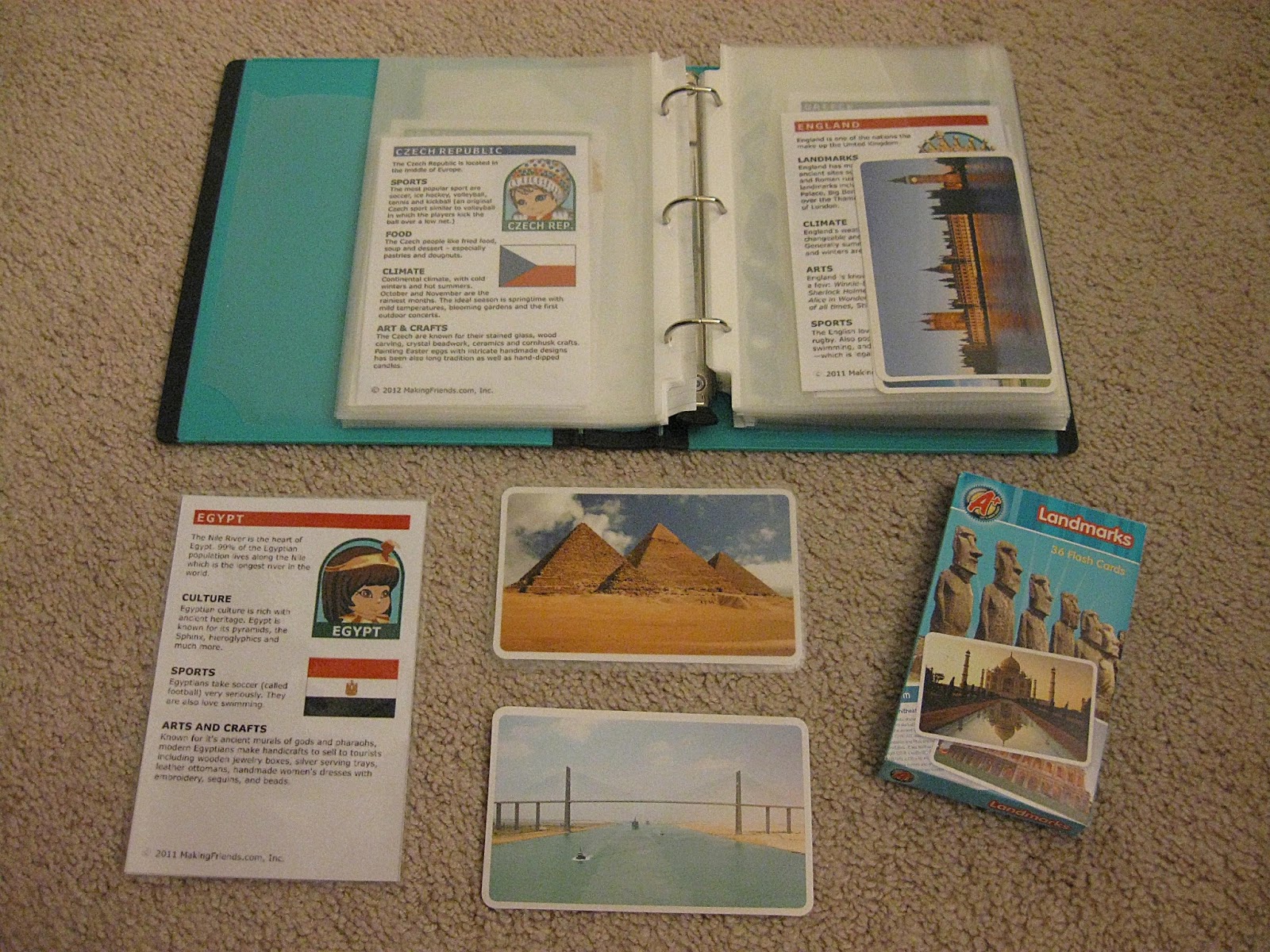
A while back I posted about these really neat passport-like cards for kids that featured lots of different countries. Here's what they looked like:
So, I fell in love with these little fact cards, but I didn't know what in the world I was going to do with them. I printed them all out, laminated them, and then felt like a loser because I spent all this time and energy (and ink!) and had not a clue what to do next.
Until . . . inspiration struck!
I've always wanted to put together continent boxes, but I know I would never really use them. But, if I can put things in a binder, well, they'll get used a whole lot more! So, I now have a small binder from Staples that will serve as my stash of international fun ideas!
Inside the binder, each country has its own page protector sleeve. Right now, I have the passport cards and Landmarks of the World cards (Target $1 aisle around back-to-school time). And yes, that is the Suez Canal on the bottom! Last year I saw a Flags of the World flashcard set at Target, too, so I'll keep my eyes out for those in July and add them to the binder. And, I'll just keep on adding to it until it's full of neat information and pictures of the countries. How easy, right?!
Do you have any ideas for keeping up with stuff like this? If so, I'd love to hear about it. Please leave a comment and fill us in! I always love, love, love reading comments, and I read every one. Do you ever read other blogs' comments? Sometimes, that's where you find the best stuff!
Good night, friends!
Feb 5, 2013
Anna Update and New Maps
It's been a while since I've done an Anna update, so I thought I would fill you in on what's been going on.
We went to the St. Jude clinic in town for a second opinion on her treatment for her basal cell skin cancer. First of all, it was just so weird to go to St. Jude. I'm sure one day I'll be a-o-kay with this Gorlin Syndrome thing, but I'm not there yet. Anyway, the doctor was wonderful, and two really great things came out of the appointment. First, the doctor got us in with a local dermatologist - and soon! No more driving a couple hours to Birmingham to see our specialist. Nice! And the icing on the cake of our visit was that Anna was NOT the first person with Gorlin Syndrome that she's seen in Huntsville. Yes, there is someone else with this extremely rare disease right in our own backyard! The doctor called the little girl's mom, and she's going to call me very soon to meet up and compare notes, so to speak. And this new family goes to the same dermatologist that we'll be going to in town. How great is God?! He knew we needed this connection, and He always takes care of us. Thank you, Lord! I'm very excited about the seeing the new derm. because Anna has a bunch of new bumps, which I think are basal cell carcinomas (skin cancer), but I don't know for sure. Her treatment for her cancer spots is this cream that kills the cells, so I sure don't want to put that stuff on good skin. I want the derm. to tell me yes or no for sure on those new bumps.
So, that's the big update. Happy news for the developments from St. Jude, and not-so-happy news for new bumps. But, you know what? God is in control. And He is good!
In other news, we recently went to a Learning Expo at the U.S. Space and Rocket Center. I love that we live so close to this place!
The girls enjoyed playing with the fun stuff while we looked around. Pretty neat! CC had a booth right next to Anna's new school's booth! I really should have taken a picture.
Funday Monday was yesterday - woohoo! We reviewed some material before The Challenge. Mary loved the Gallon Man activity from Crecia's lesson plans at CCing it one day at a time. I laminated the pieces and added velcro dots.
One of the subjects we really need to work on is Geography. We were doing so well at the beginning of the year, but we slacked up during our long break. I dusted off our homemade review book, but we have two problems with it now. If you used the Map Friends Review Book that I made for Mary, I'm sure you've noticed that some of the locations are missing or have changed starting in Week 11 (sorry about that). Apparently, CC has changed up the memory work a little since the last Foundations Guide; I should have checked the maps better when making the book (again, my apologies). The second issue with the review book is that Mary can now read (yay!), so having the names of the places on the maps is terrible for review. I decided that we needed to revamp or beloved Map Friends book. I'm going to keep everything in the book as it is, but I'm going to add some maps I've pulled from C3:
I've laminated the pages and added velcro dots, so we'll still use our map friends. I'm going to take these pages and the original review book back to Staples tomorrow and have them put it all together in one new book. Easy cheesy! You can find these great maps on C3:
file name: Geography Semester 1 with blanks.pdf
file name: Geography Semester 2 with blanks.pdf
user name: kkillingsworth
Kkillingsworth also has some really great file folder games for the upcoming weeks. If you're looking for some fun review, definitely check out her stuff! We love it!
Speaking of maps and C3, thanks to the Knox family, we've discovered a new way to review Geography:
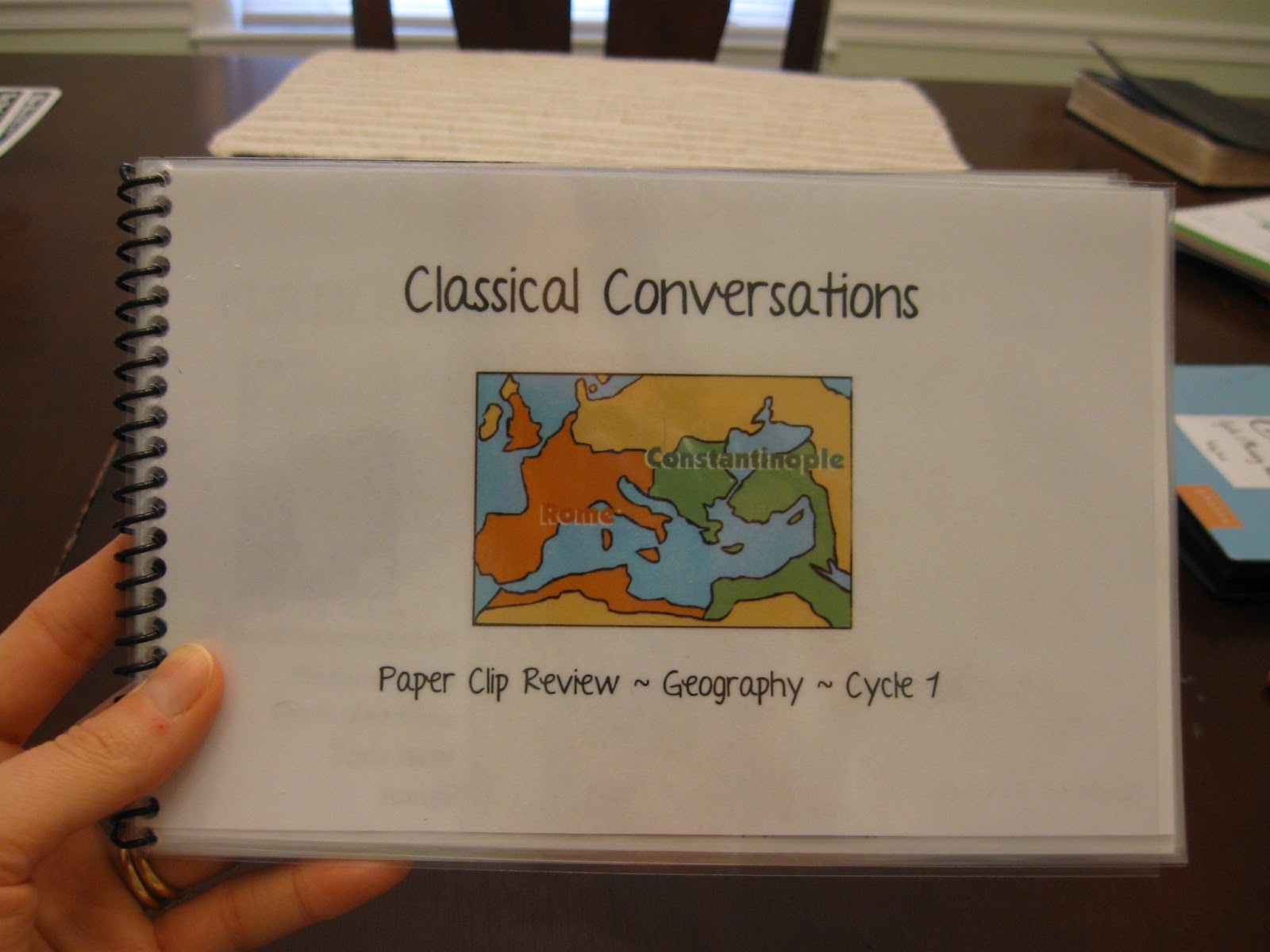
With paper clips!
(please excuse these sideways pictures... oops!)
This is a handy little book with all of Cycle 1's Geography memory work ready to go for independent review. Yes, that's right, independent! First, you print out the maps, then you take a paper clip and punch a hole for each location for that week. Then you write (we used pencil so it wouldn't show through) the names of each location on the back next to the hole. Then you laminate and repunch (the hubs used the sharp end of a screw). I got the book bound at Staples for under $5, and viola! Your child puts the paper clip where she thinks the location is, then she turns it over to see if she was correct. How cool! Even my four-year-old can do it by herself! And playing with a paper clip is pretty fun for her. ;)
You can find this really neat set of maps on C3:
file name: C1_Geo4th_wk01-24_MapNPaperClip_WklyReview.pdf
user name: KnoxFamily
Here she is in action!
Speaking of C3, I've pulled TONS of great stuff off of there lately. I'm so thankful that CC has made this resource available and that mamas are willing to share their wonderful creations! I'm actually going to put together a post of some of favorite C3 stuff soon. There is just never enough time in the day, y'all! And I still haven't gotten a chance to work on Mary's fairy review game again. Eeek! Soon, soon, soon. I have until our next Funday Monday to pull it together.
I know this post has been a little-bit-of-this and a little-bit-of-that, so I'm just going to throw one final thing into the mix:
My girls absolutely LOVE this - ha! Anna likes it the most, and she always asks to watch the kitty cat. Too sweet! She even sings along with Ginger! Love it or hate it, you'll have to admit it's pretty cute (but Ginger the Cat goes from cute to annoying speedy-quick, so watch sparingly. ;) ).
Good night, friends!
Jan 30, 2013
Cycle 2 Memory Work Flip Chart
It certainly took a long time, but I think this flip chart is much better than the one I did for Cycle 1. You may think it's a little early to start thinking about Cycle 2, but I like to be an early bird when I can. And have you checked out Pinterest lately?! Mamas are already pinning tons of ideas for the next cycle! Awesome!
If you'd like to make your own flip chart like this, the pdf can be found on C3:
username: melodystroud
file name: Cycle 2 Memory Work Flip Chart
After printing, you'll have to go to the Latin page and add the macrons yourself (those small lines above some of the letters); I didn't know how to do that on the computer. Everything is in the chart except the Bible passage, Ephesians 6:1-24. I know that some communities use different versions, so you can just type that up yourself if you're so inclined. All the pages fit nicely into a 4 x 6 photo album. I stopped by Dollar General yesterday to pick one up (True Living Brag Book to be exact), and it was only $1. I'm telling you, these little flip charts are SO much handier than flipping through that big Foundations Guide (and I'm not knockin' the FG, but you know that thing is HUGE!). And they're great to keep in your purse, too, especially if you're headed to the library. So, whew! I'm just so glad it's done now!
We returned to our CC community yesterday after an 8 or 9 week break. It wasn't supposed to be that long, but then weather and sickness pushed us back a few extra weeks. It was SO GREAT to be back! I love that Mary sees other kids learning the same things she is, and all of the children are really excited about being together. Rumor is, our class is the rowdiest; I wouldn't doubt that. ;)
Our fabulous tutor had an exciting game for the kids to play for review:
They got to go FISHING (the chairs are their boat)! On the back of each fish was a review question.
Mary's reeling one in!
The fishing game was fun for the kids, but honestly, it was stressful for me. They all had a hard time getting the magnet to land on the paper clip; it felt like it was taking for-e-ver (insert Sandlot movie clip here - remember that part? Too funny!) Anyway, the kids absolutely loved it, of course, but I was thinking, Let's speed this up! Here, let me catch one for ya! Can't we get some more questions in?! During lunch, I was talking to a sweet friend whose son is in the class with Mary. I complained (yes, I know, I know, complaining is terrible) about how long the fish game took, and then BOOM! It's like God spoke right through her to me. She said, "Yeah, but we want the kids to have fun, too, and be excited about learning."
Ouch! I was pretty embarrassed.
I can tell I'm going to have to work on the fun part of learning for a long time, probably for-e-ver. ;)
Yes, yes, I'd already fallen back into my review-machine mode. So, thank you, friend, for gently reminding me that reviewing does not always equal drilling. And thank you, Mary's awesome tutor, for creating a review game that the kids LOVED to play.
Okay, enough humble pie for me. ;) Let's end on a happy note:
Isn't this a cute picture?! In Art this week, we're studying Ghiberti. He was the Italian artist who created the bronze doors for the Baptistry of Florence in the early Renaissance. So, all the kids used clay and made three-dimensional doors with pictures that were supposed to tell something from the Bible. How cool! Mary said this door told the story of when God sent the snakes to the Israelite camp. Yikes! Ha!
Have to run, more later, friends!
This post is being submitted to Brandy's January CC Blog Carnival at Half-a-Hundred Acre Wood.
Subscribe to:
Posts (Atom)